LIVER FLUKE
Background
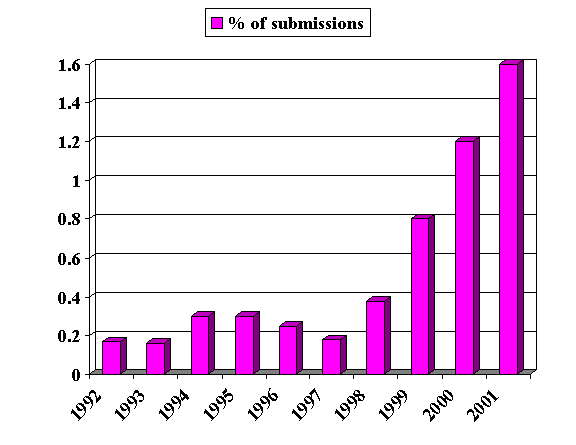
The common Liver fluke (Fasciola hepatica) is certainly living up to its name and recent reports from the Veterinary Laboratory Agency show that there has been a marked increase in the number of submissions over the last few years.
The reasons for this increase are not clear, but as several of the important stages in the life cycle are temperature and moisture-dependent, it seems likely that at least one reason is the somewhat milder, wetter weather this country has experienced recently.
Natural History
In order to understand how the parasite lives and when and why it causes disease, it is necessary to understand a little bit about the life cycle of the parasite and how it interacts with domestic stock. (VLA report, VET.Rec. Feb. 2002)
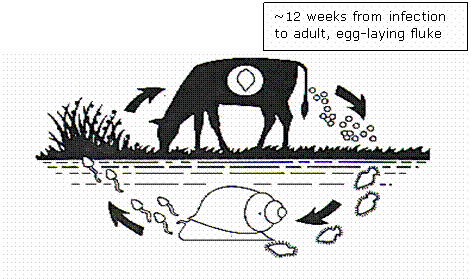
The life cycle differs somewhat from the more familiar patterns seen with the common gut worms. In the first place it takes a lot longer to complete the cycle from egg to adult fluke generally around 6 months and one reason for this is that another host is involved. This is the mud snail (Lymnaea truncatula) and it as an essential element in the development and multiplication of the fluke. As its name would suggest, it inhabits ditches, ponds, ruts and other, often temporary wet areas; it does not thrive however in places where the underlying soils are acid.
~8 weeks in snail to release of infective fluke
~8 weeks in snail to release of infective fluke
Infection
Cattle, sheep and occasionally other species, such as rabbits, acquire infection when they graze pastures that have been contaminated by infective fluke, which in turn have been released by affected snails. Hence fluke can only be picked up where snails are present, however, because the fluke take several months to mature inside cattle, adverse effects caused by fluke may not be apparent until long after stock have left the infective pastures.
After ingestion by grazing cattle, the young fluke make their way to the liver and browse through the tissue until at about 8 weeks of age they penetrate the bile ducts, where they spend the rest of their adult lives. Perhaps surprisingly, it appears to be only the adult fluke in the bile ducts that cause harm in cattle: (in contrast to sheep, where the young flukes can cause serious problems).
Harmful effects
Because the liver is such a fundamentally important organ in the body, fluke damage can lead to a variety of different problems and consequent losses. These include reduced weight gain and condition, poor feed conversion efficiency, reduced milk production and quality and poor fertility. Additionally cattle with fluke may be more susceptible to other infections, for example Black disease and salmonellosis.
Control
In principle, there are two main avenues for control:
- One is to treat infected animals to remove the fluke so that they no longer can cause damage or produce eggs to contaminate the pasture.
- The other is to take steps to ensure that grazing cattle are not exposed to pastures inhabited by mud snails.
In reality, it may be impractical to avoid contaminated pastures and it is virtually impossible to eliminate snails without taking draconian, probably uneconomic and possibly unrealistic measures.
Treatment
There are a relatively small number (7) of products licensed for the treatment of liver fluke in cattle; several of these products are only available as combinations with other parasiticides. They are available as injections or drenches and their specific efficacy varies somewhat, primarily in relation to the extent to which they kill immature fluke. All the products are effective against adult fluke and this is a prerequisite for use in cattle, as it is the adults that do the damage and lay the eggs. Nevertheless, it is important to get advice as to when and how frequently treatment with the different products is recommended.
Although there may some overlap, there are broadly two periods when treatment for fluke should be considered:
- Between November and March to remove adult flukes and prevent damage to the cattle.
- Between April and August to remove adult flukes and prevent the pastures being contaminated with fluke eggs.
For specific problems or in the face of high challenge, it may be necessary to increase the number/frequency of treatment. One final word of caution, resistance has recently emerged to one of the popular flukicides and it could potentially appear in others. It is important therefore to check with your veterinary surgeon to determine if there are any reports of resistance in the area and to ensure that treatment is carried out correctly.
Final Word
Whilst veterinary and animal science has progressed over time, there is still a lot of sense in the recommendations provided in parasitology texts from the 1800s, in an age when knowledge of the parasite was incomplete and when there were no specific flukicides available:
..if flukes be suspected, the necessary indications for checking the disorder are few and simple. If on low grounds, the cattle must be moved to higher or drier pastures. There must be a frequent change of fodder and the substitution of good manger food for marsh-grown grass. Beans, peas and fine hay will be particularly suitable.
T. Cobbold, The Internal Parasites of our Domestic Animals, 1873
Key Points
- Liver fluke is a common parasite and it is increasingly causing problems in stock.
- Cattle become infected when grazing pastures inhabited by the mud snail, which is a crucial element of the life cycle.
- It takes several months for ingested fluke to mature into adults in the bile ducts, where they cause damage and produce eggs that are passed out in the dung.
- Liver damage, caused by fluke, leads to a variety of problems in both young and adult cattle.
- Treatment of infected cattle in the winter and summer kills adult fluke, improves the health of cattle and helps limit contamination of the pasture.